Provenance & Authentication
Chain of ownership, family certification, institutional validation
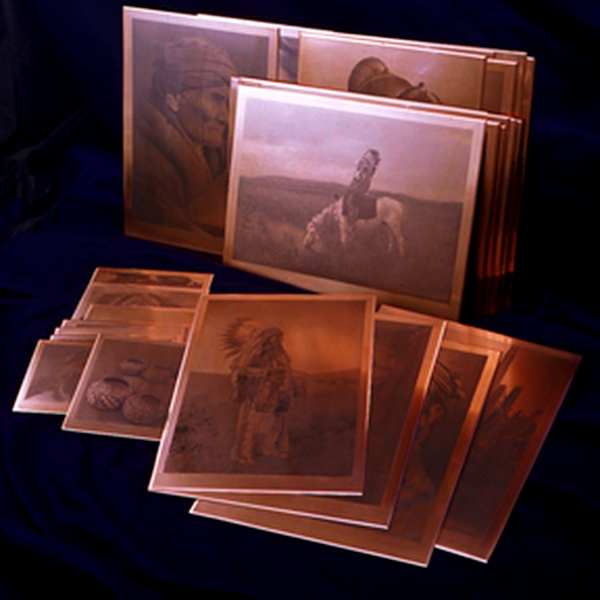
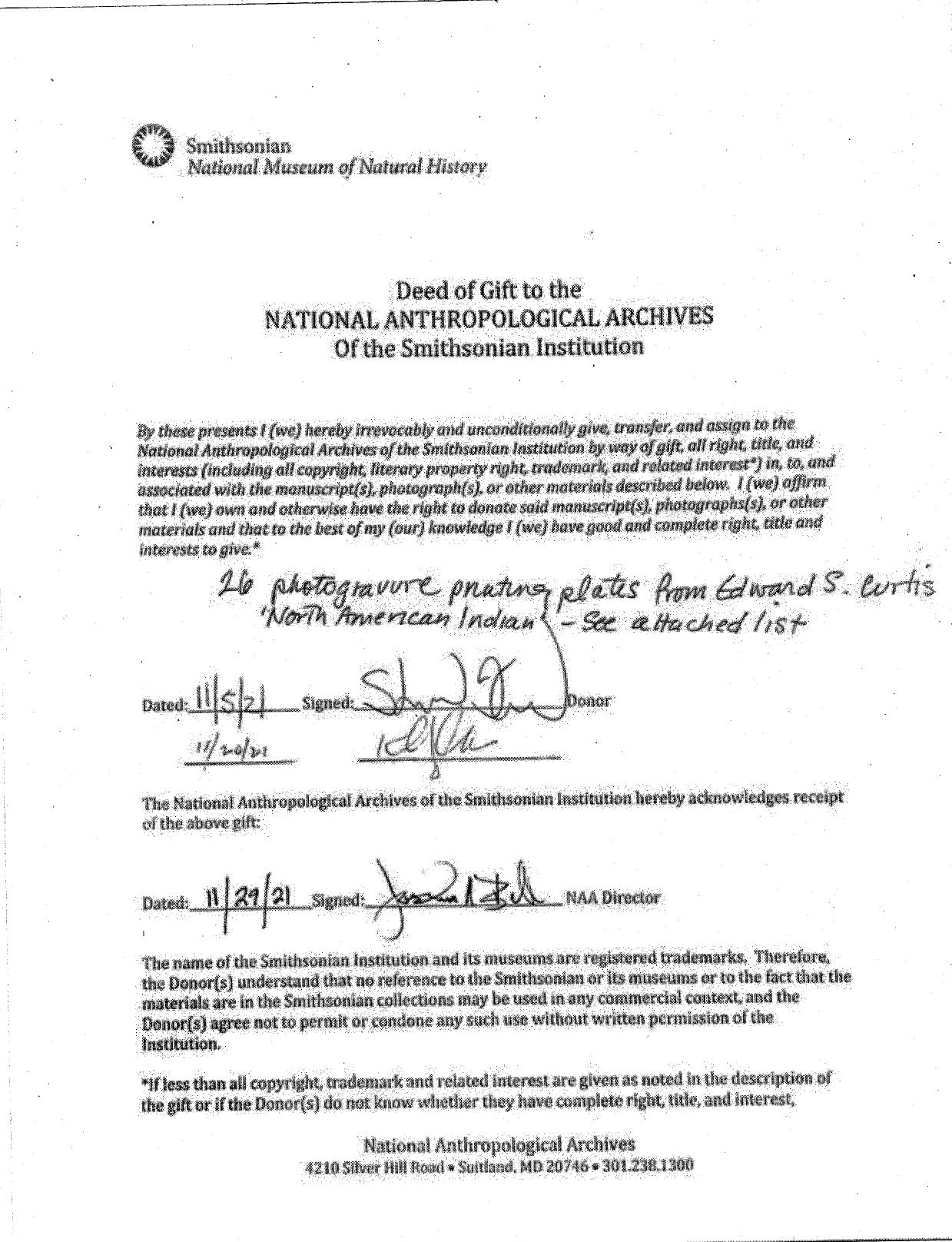
The copper photogravure plates from The North American Indian have a documented chain of ownership stretching back to Edward Curtis himself. Two anchor documents support the authentication: Florence Curtis Graybill's 1983 letter from Curtis's daughter, and the Smithsonian deed of gift from the November 2021 donation to the National Anthropological Archives. (A separate earlier donation was made through the National Museum of the American Indian, formerly the Heye Museum.) Family certification and institutional acceptance, decades apart, of plates from this collection.
The chain of ownership
The plates have moved through ten distinct ownership periods between their original production and the present:
- Edward S. Curtis, Curtis Gravures Company, New York, NY — 1906–1909
- Edward Curtis, J.P. Morgan, and J.P. Morgan, Jr., The North American Indian, Inc., New York, NY — 1909–1923
- J.P. Morgan, Jr., The North American Indian, Inc., New York, NY — 1923–1935
- Charles E. Lauriat Company, Boston, MA — 1935–1972
- Cerro Gordo Associates, Santa Fe, NM — 1972–1973
- The North American Indian, Inc. (Massachusetts and Delaware corporations) — 1973–1976
- Classic Gravure Corporation (California corporation) — 1976–1982
- ZAK Partnership (Zerbe-Anderson-Kern), California partnership — 1982–1985
- Jointly owned by Kenneth Zerbe and Steven Kern — 1985–2013
- Kern and Zerbe, each in their Private Collections — 2013–present
The Lauriat rediscovery
The plates were largely forgotten between 1935 and the 1970s. After the assets of The North American Indian, Incorporated were liquidated in 1935, the remaining materials — nineteen unsold sets of the published volumes, thousands of individual prints, sheets of unbound paper, and the original copper photogravure plates — were sold to the Charles Lauriat Company, a rare-book dealer in Boston.
The plates remained in the Lauriat Company's basement, in their working production state (steel-faced, covered in protective material, stored in wooden boxes), for nearly four decades. Their rediscovery in the early 1970s sparked the revival of public interest in Curtis's work.
Check the authenticity
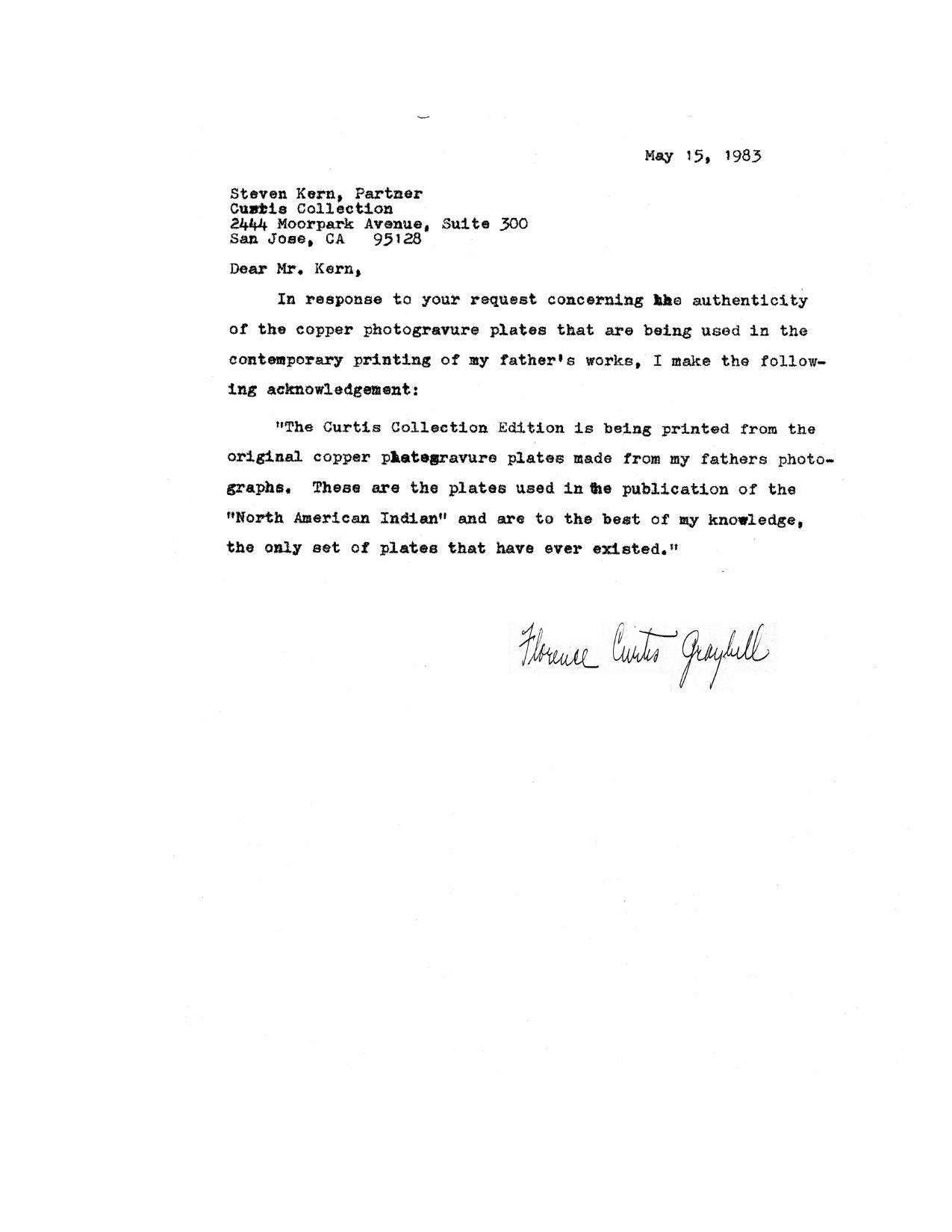
In May 1983, Florence Curtis Graybill — Edward Curtis's daughter — issued a written certification of these plates' authenticity. Her letter, addressed to Steven Kern, partner in The Curtis Collection, states:
"The Curtis Collection Edition is being printed from the original copper photogravure plates made from my father's photographs. These are the plates used in the publication of the 'North American Indian' and are to the best of my knowledge, the only set of plates that have ever existed."
The phrase "the only set of plates that have ever existed" — from Edward Curtis's own daughter — is direct family confirmation that no parallel set of plates was ever made.
Institutional placements
Plates from this collection have been gifted to institutions, including:
- The Smithsonian Institution — National Museum of the American Indian (formerly the Heye Museum)
- The Smithsonian Institution — National Anthropological Archives (26 plates accepted November 2021)
- The Center for Creative Photography, Tucson, Arizona
- The Seattle Art Museum
- The Montana Historical Society
- The University of California, Davis
- The University of Washington Library
- The North Dakota Cultural Center
- The Brinton Museum
- The Booth Museum
- The Muskegon Museum
- The Cahuilla Tribe
- The Skokomish Tribe
The Curtis Collection maintains a record of all such placements, available on request.
The broader market context
A serious Curtis buyer should know that the broader Curtis market has a documented history of complications. Outright forgeries of Curtis material — particularly fake "gold-tones" — were common enough during the period of Curtis's commercial rediscovery that some examples were physically defective and visibly failed in gallery display. The original gold-toned photographs are a distinct Curtis process, but in the market, items have been marketed as gold-tones that bear little relationship to Curtis's actual work.
Beyond outright forgeries, prints have been produced from Curtis's original plates well after the original print runs of 1907–1930. The Classic Gravure Corporation period (1976–1982) included new printings from the original plates — real prints, made from real plates, but not historically vintage. These exist in the market and are distinct from both pre-1930 vintage prints and from the plates themselves.
The plates in this collection are the source — the artifacts from which all of these reproductions, authentic and otherwise, ultimately derive. They are not prints, and they cannot be confused with prints. They are unforgeable in the sense that they are the original implements from which all related prints would have been made.
What every buyer receives
Each plate sold through CurtisCamp comes with:
- Confirmation of its place in the canonical provenance chain
- Reference to Florence Curtis Graybill's 1983 authentication letter (letter on file)
- Documentation of conservation history (cleaning to copper, polishing, archival storage)
- Sale documentation from CurtisCamp LLC
- Full print rights transferred with no restrictions